
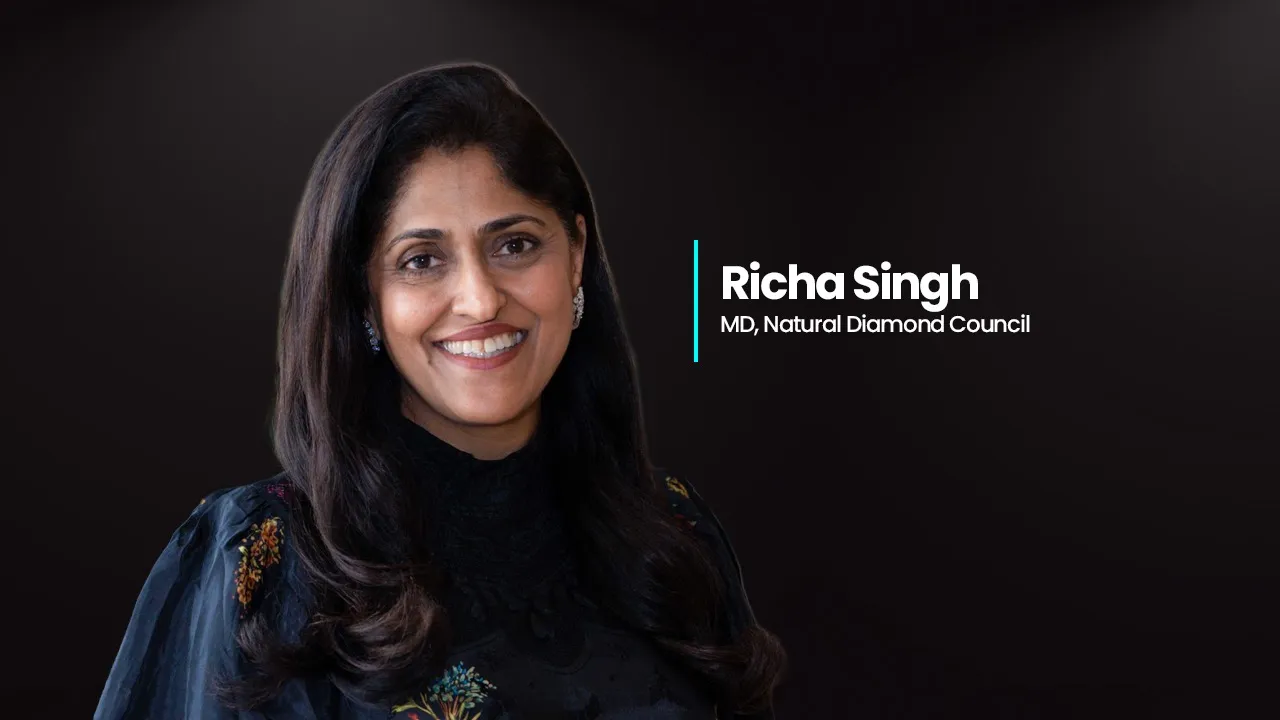
Richa Singh hasn’t simply climbed the corporate ladder—she has carried its weight, step by step, across nearly three decades of work in advertising, marketing, and business leadership. She has moved through environments that didn’t always open their doors easily, yet kept stepping in anyway. Through late nights, product launches, and moments of self-doubt that often go unspoken, she remained steady in her presence—professionally, as a mother, and as someone unwilling to accept the idea that excellence in one identity must diminish another.
Today, as Managing Director of the Natural Diamond Council, Richa leads with a calm, assured authority that feels earned rather than performed. But her distinction lies less in the title she holds and more in how she uses it. She has built an all-women team within one of the world’s most legacy-driven industries. She has reframed flexibility not as a corporate benefit, but as a guiding philosophy. In many ways, she has become the leader she once needed.
In this conversation, Richa reflects on the unspoken weight of guilt many women carry, the assumptions we form about ourselves long before the world imposes its own, and the internal shift that came with motherhood—when she realised the workplace was not originally designed for the version of her she had become. She speaks about her team, the women rising behind her, and those across the diamond ecosystem—in factories, design studios, and boardrooms—who are finally stepping into long-awaited visibility.
Edited excerpts:
Q: Could you tell us a little about your journey? What experiences and milestones have shaped your path to becoming Managing Director at the Natural Diamond Council?
A: I began working at 20, which means I’ve been in this world for almost 30 years now. My career started in advertising, then moved into marketing, and eventually into business leadership. Across very different organisations, one thread remained constant: the consumer. I quickly understood that the consumer sits at the centre of everything—how they think, how they shift, how their lives evolve, and how their expectations evolve with them.
Another defining transition was the move from being an individual contributor to leading teams. That shift changes your lens entirely. You begin to realise that your identity is no longer just about personal output—it is reflected in what your team builds together. It’s no longer about hiring the strongest individual in every function, but about assembling people who complement each other, who bring balance, who create chemistry, and who can see what others might miss.
Motherhood added an entirely new dimension. It made me far more deliberate about shaping a workplace where people feel supported not only as professionals, but as complete individuals. My goal as a leader has been to build an environment where people can thrive in every part of their lives, without being forced to choose one identity over another.
Q: As Managing Director at the Natural Diamond Council, how do you define the core marketing challenge for natural diamonds today, and how do you market ‘natural diamonds’ as a category rather than simply promoting individual brands or retailers?
A: At its core, the challenge is about shifting mindset. Some responsibilities belong to individual brands—design, storytelling, retail experience. But there is another layer that belongs to the industry as a whole: facts, education, and a shared, credible language.
Our focus has been to own that broader narrative—provenance, ethics, sustainability, and everything that extends beyond a single transaction into what consumers are genuinely seeking today. We work with over 1,500 retailers and reach around 60 million people through our platforms. Yet the challenge remains that category-building often sits lower on individual brand priority lists, even when it benefits the entire ecosystem.
Q: How are younger consumers reshaping the perception of diamonds today, and what does that mean for how the category is marketed?
A: Millennials and Gen Z now account for more than 70% of the luxury goods market. Their expectations are fundamentally different—they look for transparency, sustainability, and meaning rather than just ownership or transaction. Deloitte data indicates that roughly 58% of consumers aged 20–25 view diamonds as a long-term value category.
In recent years—especially through global uncertainty—there has been a clear shift toward things that feel lasting. Natural diamond jewellery fits into that shift naturally. It is not fast fashion; it is enduring, transferable, and value-retaining. Each piece carries a narrative that can be passed down across generations.
The marketing approach has therefore had to change. It is no longer about a single campaign or a single ambassador. Consumers now absorb information across multiple touchpoints at once. The category has to exist everywhere simultaneously—not sequentially, but in parallel.
Q: What role do content, social media, and creators play in shaping consumer perception in a category like natural diamonds?
A: Discovery in luxury is increasingly digital-first. Consumers spend significant time researching, comparing, and narrowing choices long before they ever enter a physical store. By the time purchase happens in-store, much of the conviction has already been shaped online.
Alongside this, a vibrant creator ecosystem has emerged. Designers, influencers, and independent voices are not just amplifying messages—they are actively shaping them. Many have become trusted interpreters of style and meaning, translating what consumers are looking for into something more personal and relatable.
Q: The diamond and luxury sector has traditionally been male-led. Where are you seeing meaningful shifts today, if any?
A: I am genuinely proud to lead an all-women team. The foundation of change lies in access—opportunity, exposure, and platforms that allow people to grow.
Across the industry, the shift is visible. Women are leading in retail, jewellery design, and manufacturing. There are female-founded lab businesses, daughters taking over and transforming family enterprises, and women entering fields like diamond cutting and polishing with growing presence.
We are not yet at parity—far from 50% across the board—but the direction is clear. More organisations are now consciously recognising that talent has no gender, and opportunity should reflect that.
Q: In the Indian market especially, how do festivals, weddings, and generational gifting shape the way diamonds are communicated?
A: Weddings remain the backbone of the industry and will continue to do so. But a quieter transformation is underway: jewellery is moving out of the locker and into daily life.
Consumers no longer want pieces reserved only for rare occasions. They want jewellery that lives with them—worn, seen, experienced. This shift has driven trends like layering, stacking, mixing, and investing in smaller, more versatile pieces.
During the pandemic, for example, we explored content around Zoom-era visibility—where only the face and earrings were seen, prompting a renewed focus on expressive, everyday jewellery. Today, the idea is simple: jewellery should move with your life, not sit apart from it.
Q: You’ve encouraged women to ask unapologetically for flexibility. What prevents many from doing so even today?
A: We often assume that asking for flexibility is a sign of weakness—and that assumption stops many before they even speak. But silence comes at a cost. If I need to leave early because my child has an exam and I don’t say it, I end up compromising either my work honesty or my personal responsibility.
There is no need for that trade-off. Saying, “I need to work from home today because my child has an exam.” is not an admission of limitation—it is clarity.
We are not single-dimensional beings. We exist as professionals, mothers, daughters, partners—all at once. Work and home inevitably overlap, and building a culture where that overlap is acknowledged without judgement is what real flexibility looks like.
There are days when work takes absolute priority—launches where teams push beyond limits and deliver in record time. And there are days when life must come first. In the long run, it balances out when trust exists on both sides.
Q: Is there still a perception penalty attached to ambition for women leaders?
A: There was a time when ambition in women was often interpreted through a lens of sacrifice—that success must have come at the cost of something else. That framing is gradually shifting.
Today, more women are navigating both ambition and personal life without treating them as mutually exclusive. Capability is not gendered. The focus is slowly moving toward ensuring that opportunities are not withdrawn simply because of assumptions about life stages or responsibilities.
Much of my own journey has been shaped by leaders who gave me space to operate fully. When people are trusted with that space, they often contribute far beyond expectations.
Q: As a juror for Social Samosa’s Superwomen, what advice would you give to women stepping into new leadership roles today?
A: Be proud of how far you’ve come—and don’t shrink that pride. Too often, we self-edit before anyone else does. We question whether we should accept a role because of personal circumstances, while rarely seeing the same hesitation reflected in men in similar situations.
Stop placing invisible ceilings on yourself. Ask for what you need. Seek help when required. Nothing changes unless it is voiced.
And perhaps most importantly, step away from being your own harshest critic. Trust your capabilities. Acknowledge them. And extend the same generosity to other women that you hope to receive yourself—because that is how lasting change in leadership culture is built.