
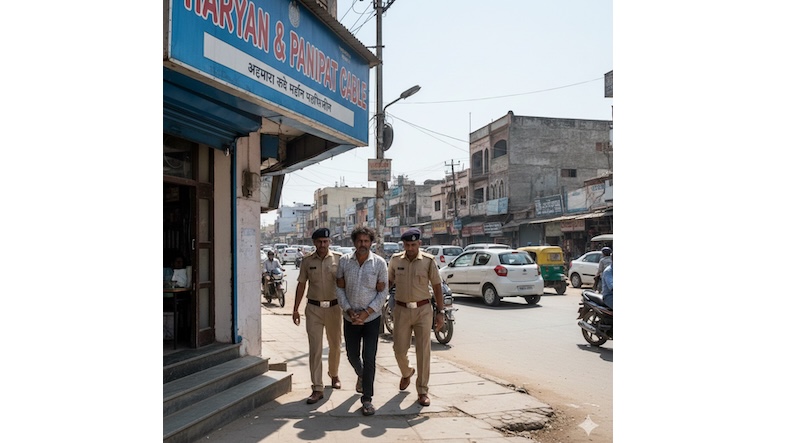
NEW DELHI: A cable operator in Haryana’s Sonipat district has been arrested for allegedly distributing unauthorized television broadcasts, exposing what industry insiders describe as a rapidly expanding underground market for unencrypted TV signals across northern India.
According to reports, Anurag Narwal—widely known in the area as Nura—was taken into custody in Gohana after authorities accused him of illegally transmitting JioStar channels without the required authorization. A First Information Report (FIR) has been filed under provisions of the Copyright Act, 1957, citing criminal copyright infringement and possession of equipment allegedly used for unlawful signal distribution.
Confirming the arrest, Gohana police station inspector Arun Kumar said the accused was detained before being released on bail.
“The accused was arrested and was released on bail. We are investigating the matter further,” Kumar stated.
The case emerged following a raid at a property in Kathmandi, Gohana, where investigators reportedly recovered two optical transmitters and two optical receivers from the upper level of a commercial building. Authorities believe the equipment was being used to relay pirated television feeds to subscribers.
Investigators have since traced the source of the unauthorized broadcasts to a multi-system operator based in Panipat. Police are now examining whether other cable operators in the region were connected to the same supply chain, raising concerns that a broader network may have been redistributing unencrypted television signals across several districts.
One of the major challenges facing investigators is the absence of watermarking technology on the leaked feeds. Unlike encrypted satellite transmissions or digital streaming platforms that embed forensic identifiers, unencrypted fiber-distributed signals can be copied and retransmitted without leaving a clear trail back to their origin.
A senior executive from a major entertainment broadcaster, speaking on condition of anonymity, described the issue as one of the industry’s most pressing vulnerabilities.
“The biggest loophole today is unencrypted distribution. When feeds are shared without watermarking, it becomes nearly impossible to trace who extracted it, who retransmitted it, and where the leak originated. It’s a blind spot that pirates have learned to exploit very effectively.”
Broadcasters say they have invested heavily in anti-piracy systems, monitoring tools, and enforcement mechanisms, but those defenses can be undermined when content moves through distribution channels that operate outside secure, encrypted ecosystems.
“We keep closing the gaps at our end, but unencrypted feeds undo everything,” another broadcaster executive said.
The incident comes as the Ministry of Information and Broadcasting intensifies efforts to combat content piracy nationwide. In a consultation notice issued on 7 November 2025, the ministry announced a review of current enforcement and monitoring frameworks aimed at tackling unauthorized distribution affecting films, television channels, and OTT platforms.
For many stakeholders, the Haryana case highlights a long-standing industry demand: mandatory watermarking of broadcast feeds. Broadcasters argue that without traceable identifiers embedded in every signal, piracy investigations will remain reactive rather than preventive.
Industry representatives warn that unless stronger safeguards are introduced, illegal redistribution networks will continue to proliferate, turning enforcement into a costly and repetitive game of cat and mouse—one that drains revenue from both broadcasters and legitimate cable operators while allowing pirates to stay several steps ahead.