For decades, transgender people in Indian media were either erased entirely or flattened into familiar stereotypes. Mainstream films and television often confined trans characters to narrow roles—comic relief, antagonists, or figures defined by tragedy—leaving little space for narratives grounded in lived reality. While recent years have brought more layered portrayals and a gradual widening of visibility, representation remains uneven. Progress is visible, but unresolved questions linger about authenticity, complexity, and who ultimately holds the authority to tell these stories.
In parallel, social media has quietly rewritten the rules of representation. For many queer and trans individuals, digital platforms became the first stage where visibility felt possible at all. YouTube, Instagram, and similar spaces enabled creators to tell their own stories long before traditional media was willing to listen, shifting narrative control from institutions to individuals.
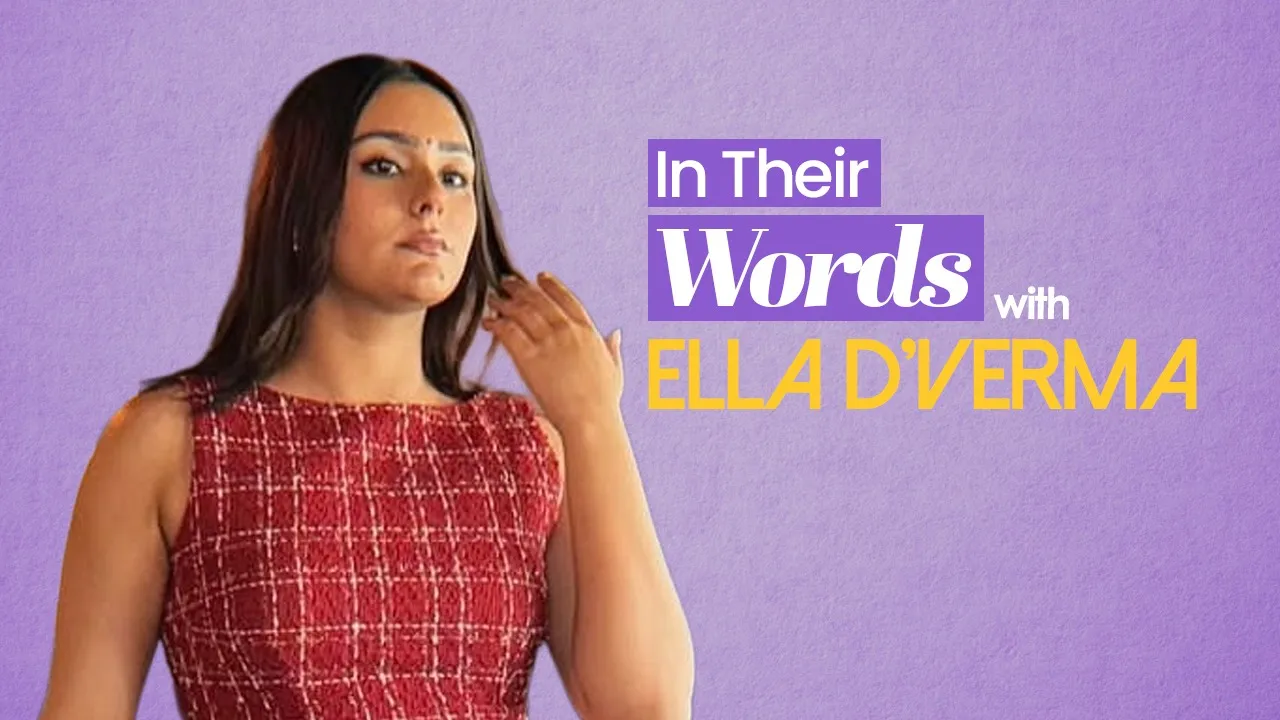
Ella D’Verma stands at the centre of this transformation. A model, actor, and digital creator, she initially built her presence online by speaking openly about her own journey, offering the kind of honesty and visibility she rarely encountered while growing up. Over time, her work expanded beyond gender identity into fashion, beauty, relationships, culture, and commentary on contemporary life. In doing so, she has become part of a new wave of creators reshaping not only how trans people are seen, but who gets to define those representations in the first place.
In this episode of In Their Words, Ella reflects on growing up without representation, navigating an industry that often foregrounds identity over craft, the layered meaning of family, and why visibility—while powerful—is never enough on its own.
Edited Excerpts:
Q. You’ve spoken before about always knowing who you were, even before you had the language for it. Looking back, do you think growing up without representation forced you to become more self-aware than most people your age? And how do you think queer/trans representation in the media is shaping younger queer people today?
When you grow up without representation, confusion doesn’t linger for long. You’re constantly observing, decoding, and piecing yourself together without a reference point. That inevitably builds a kind of early self-awareness—sometimes even an intense hyper-awareness—because you’re trying to name something the world hasn’t yet named for you.
Today, representation offers younger queer people something I never had: context. It gives them reassurance that what they feel is real, shared, and valid.
But representation also has to go further than visibility. It needs to hold nuance, contradiction, and the full spectrum of experience—not just simplified versions that are easy to consume.
Q. What assumptions do people make about you today that are completely different from before your transition? What has that taught you about gender and social power?
Before my transition, people projected ideas of strength, authority, and emotional range onto me based on how they read my gender. Afterward, those assumptions shifted—toward softness, vulnerability, and at times even diminished capability.
What it really revealed to me is that gender functions like a social currency.
It influences how seriously you’re taken, how safe you feel, and how much space you’re allowed to occupy. Experiencing both sides of that equation has been deeply revealing.
Q. What’s something about your family’s journey that people outside the queer community often misunderstand? How have chosen family and biological family evolved for you over time?
People often imagine family as a straight line—conflict followed by resolution, rejection followed by acceptance. But real family journeys are far more layered. Love, confusion, learning, and unlearning often coexist in the same moments.
For me, chosen family didn’t replace my biological family—it expanded the idea of what family can be. Over time, both have evolved. My biological family has grown in ways I value deeply, while my chosen family has remained a steady anchor through it all.
Q. Being visible as a queer creator can bring opportunities, but also lead to professional pigeonholing. Have you experienced that tension? How did it affect your work?
Yes, absolutely. Visibility can come with boundaries you never asked for. You’re seen—but often through a very specific lens.
There have been times when my identity was centred far more than my craft, and that can feel limiting.
Over time, I’ve learned to actively reshape that narrative. I choose projects that allow me to demonstrate range and depth beyond identity. At the same time, I’ve also learned to value my perspective—it just can’t be the only thing people see.
Q. When brands first approached you, did it feel like they were more interested in your identity than your work? Has that changed?
In the early days, yes—my identity often felt like the headline, while my work was treated as secondary. I understood the context, but it still felt reductive.
It bothered me because I’ve always seen myself primarily as a creator.
The difference now is intention. I’m far more selective, choosing collaborations with brands that see the full picture—not just who I am, but what I bring.
Q. Do you think the creator economy rewards authenticity, or does it reward identities that can be neatly packaged for brands?
It does both, but not evenly. Authenticity is celebrated, but usually within boundaries that feel safe and structured for brands.
There’s a clear preference for identities that can be easily understood and neatly packaged.
Real authenticity, however, is often messy and complex—and not every platform or brand is prepared for that. So creators are constantly negotiating between honesty and marketability.
Q. What separates a brand that simply works with queer creators from one that genuinely invests in queer storytelling?
It comes down to intent and continuity. Working with queer creators can sometimes be about visibility, timing, or alignment with cultural moments.
But genuine investment means going further—beyond token gestures or seasonal campaigns. It involves creative trust, long-term commitment, and storytelling that isn’t limited to Pride cycles.
It’s the difference between participation and partnership.
Q. Have we moved from queer invisibility to visibility—but not yet to complexity?
We’ve certainly moved toward visibility, but complexity is still catching up.
Queer identities are still often defined primarily through the lens of identity itself.
True progress would mean queer people existing fully in narratives where their queerness is not the central subject—where they are simply protagonists, professionals, lovers, villains, and everything in between.
Q. Has your understanding of femininity and beauty standards changed over time? Do you feel pressure to perform “acceptable” trans femininity?
My understanding of beauty has changed entirely. I’ve seen how femininity is valued differently depending on who expresses it, and how narrow the boundaries of “acceptable” femininity can be—especially for trans women.
Yes, that pressure exists. There’s often an expectation to fit into a version of femininity that feels more comfortable for external audiences.
But I’ve learned that authenticity ultimately carries more depth. For me now, beauty is about alignment—not approval.
Q. Why do audiences and media seem more comfortable with queer pain than queer joy or success?
Queer pain fits a familiar narrative structure—struggle, survival, resilience. It’s something audiences can consume with emotional distance.
Queer joy and success disrupt that comfort. They demand presence, equality, and full recognition.
That can be harder for audiences still adjusting to seeing queer lives beyond suffering. But shifting that narrative is essential. We deserve celebration as much as empathy.
Q. What would real progress in trans inclusion look like ten years from now?
It would mean trans inclusion no longer being treated as a special category or conversation.
Instead, it would be embedded naturally into systems, industries, and storytelling. Trans people would be present across roles, hierarchies, and narratives without exceptionality attached to it.
Most importantly, inclusion would be structural—not conditional. Safety, dignity, and opportunity would not depend on context.
And in that world, what is currently seen as “progress” would simply be the standard.